(Part – I)
Communal Polarisation in Mira Road
Irfan Engineer & Neha Dabhade
06/08/2026
Introduction
The Mira Road/Mira-Bhayander suburb of the Mumbai Metropolitan Region has emerged as communally sensitive area in the recent past. The area was recently in news for the communal tensions that took place on account of Bakri Eid. It has witnessed communal tensions and polarization even before this recent incident. However, in order to understand these tensions in this area, it would be helpful to look at the background and the evolution of this area.
- The Demographic Origins of Mira Road and Naya Nagar’s “Ghetto” Designation
Mira road emerged as a locality not very long ago. The rising rates of real estate in Mumbai, the aspirations of the middle-income group, labourers, young couples to own a shelter made Mira Road viable and transformed it into a growing real estate haven. The connectivity with local trains also helped the process along with the keen interest taken by the Builders/ developer lobby in this area which saw lucrative opportunities in burgeoning real estate in this area. One of the aspects of emergence of this area can be attributed also to communal riots in Mumbai. As is the case in other parts of India, after communal riots and subsequent displacement- voluntary or involuntary, the Muslims were pushed into newer localities, leading emergence of “ghettos”. Naya Nagar in Mira Road is one such areas in Mumbai.
According to Census data of 2011, Hinduism is majority religion in Mira and Bhayander city with 68.96 % followers. Islam is second most popular religion in city of Mira and Bhayander with approximately 16.28 % following it. In Mira and Bhayander city, Christianity is followed by 6.01 %, Jainism by 5.67 %, Sikhism by 0.53 % and Buddhism by 1.86 %. Around 0.14 % stated ‘Other Religion’, approximately 0.54 % stated ‘No Particular Religion’.
The characterisation of Naya Nagar as a Muslim enclave is best understood as a consequence of post-riot migration patterns rather than a recent or unilateral phenomenon. Following the 1992–93 Bombay riots, a substantial number of Muslim families from South Central and Central Mumbai relocated to Naya Nagar, a trend reinforced by rising property prices in the city core; concurrently, Hindu residents who secured better economic opportunities elsewhere gradually moved out, consolidating the locality’s present demographic composition, with 2011 Census data indicating that Muslims constituted roughly sixteen per cent of the Mira-Bhayander Municipal Corporation’s population, concentrated predominantly in and around Naya Nagar.
Notably, the area’s founding narrative was explicitly pluralist rather than sectarian. Naya Nagar was established by Syed Nazar Hussain, who in 1979 invited both Shiv Sena founder Bal Thackeray and Indian Union Muslim League leader G.M. Banatwala to jointly inaugurate the colony — a gesture made before the undivided Shiv Sena had formally adopted Hindutva as party ideology in 1985. Long-term residents of both communities have generally described the locality’s social history as one of routine coexistence rather than segregation; one local activist, while acknowledging that post-riot migration made Nayanagar “a larger ghetto,” simultaneously emphasised that Hindus and Muslims coexisted without communal friction for decades, citing a Ganesh temple located near the eventual epicentre of the 2024 violence where both communities have jointly participated in annual festivities for roughly thirty years.
It should be noted, however, that asymmetric residential exclusion does appear to operate in the adjoining, Hindu-majority Shanti Nagar locality, where Muslim residents reportedly encounter difficulty securing rental housing — a pattern of informal segregation that commentators have compared to similar dynamics observed in other Indian metropolitan contexts. Scholarly and journalistic critiques of the “ghetto” framing have argued that this asymmetry is analytically significant: Muslim-majority localities are routinely subject to pejorative labelling and heightened scrutiny, while comparably exclusionary Hindu-majority areas escape similar characterisation. At the more extreme end of public discourse, Hindutva-aligned commentary during the period of unrest advanced considerably more inflammatory and empirically unsubstantiated claims — including assertions that Muslims from Mumbra and other cities had migrated to the area specifically to assert demographic “dominance,” and that the locality had become a centre of religious conversion through coercive means. Such claims should be treated as contested political assertions rather than established fact; their circulation nonetheless illustrates how demographic description was actively instrumentalised in the discourse surrounding the violence.
- Political Competition and the Intensification of Hindu Nationalist Rhetoric
The communal polarization in Mira Road intensified due to the competition amongst the political players in the area who resorted to communal and hateful narratives to strengthen their political prospects. For instance, the trajectory of local legislator Geeta Jain illustrates how electoral competition within the Bharatiya Janata Party contributed to escalating communal rhetoric in the area. Jain contested the 2019 Assembly election independently, as a rebel candidate on an explicitly secular platform emphasising development, women’s rights, and employment, having previously attempted, in 2015, to organise an iftaar event using municipal funds. Her subsequent political repositioning was gradual but pronounced: by March 2023 she was flagging off a Hindu Jan Akrosh Morcha organised by Hindutva-affiliated groups, and by January 2024 she was publicly declaring, in the immediate aftermath of the violence, that Hindus required only “five minutes” to demonstrate numerical and physical superiority over Muslim residents — a statement that garnered substantial approval among Hindu nationalist constituencies.
This repositioning cannot be understood in isolation from the intra-party contest for the BJP ticket ahead of the 2024 elections, which involved at least two rival aspirants similarly deploying communal symbolism: Ravi Vyas, the BJP’s district president, who inaugurated a scaled replica of the Ayodhya temple in the constituency, and former legislator Narendra Mehta, who scheduled a competing religious procession along a route substantially overlapping with the 2023 Hindu Akrosh rally (subsequently cancelled following intervention by the Deputy Chief Minister).
The Shiv Sena (Shinde faction) organised a further motorcycle rally invoking Ram Rajya themes. Local political observers characterised this competitive escalation as symptomatic of an absence of substantive development initiatives in the constituency, with communal polarisation serving as an alternative electoral strategy.
This pattern carried subsequent legal consequences. In March 2024, a writ petition was filed before the Bombay High Court seeking action against Jain, fellow BJP legislator Nitesh Rane, and Telangana legislator T. Raja for allegedly delivering speeches inciting the January violence. Local MLAs Geeta Jain and Nitesh Rane reportedly tried to lead a Hindutva rally in the affected areas after the violence took place. They even gave the police an ‘ultimatum’ to let them conduct a rally as well. Rane even tweeted during the tense period, a part of which said “chun chun ke maarenge.”
The High Court directed police in April 2024 to review recordings and transcripts of the relevant speeches, following which criminal cases were registered against Rane and Jain under Sections 153A (promoting communal enmity), 153B, 143, 504, and 506 of the Indian Penal Code, along with provisions of the Maharashtra Police Act. This judicial intervention indicates that the rhetoric in question was subsequently treated by the courts as potentially constituting actionable incitement rather than protected political speech.
An examination of the electoral trajectory of Geeta Jain provides important insights into the intersection of electoral politics, communal polarization, and urban political economy in Mira Bhayandar. Jain was elected as an independent candidate from the Mira Bhayandar Assembly constituency in 2019, defeating the Bharatiya Janata Party (BJP) candidate, Narendra Mehta, by a margin of approximately 15,000 votes. Belonging to one of the prominent real estate developer families in the region, she projected herself as a politically independent and socially inclusive leader. As discussed earlier, her public outreach included organizing Iftaar gatherings for the Muslim community, signalling an attempt to cultivate support across religious groups. Given the demographic composition of the constituency, it is plausible that Muslim voters contributed to her electoral success.
However, her subsequent political positioning, particularly in the aftermath of the communal violence in 2024, reflected a markedly different public stance that was widely perceived as critical of, or antagonistic toward, the Muslim community. This shift may have altered her electoral support base and constituted one of several factors contributing to her defeat in the 2024 Assembly election. She finished a distant third, securing only 23,051 votes, while Narendra Mehta won the seat with 144,376 votes and Muzaffar Hussain received 83,943 votes. Although multiple political and electoral factors likely shaped this outcome, her changing political positioning appears to have diminished the cross-community appeal that had characterized her earlier campaign.
This political repositioning, despite its apparent electoral costs, may also be situated within the broader political economy of urban development in Mira Road. The region’s real estate sector has long been shaped by patterns of residential segregation, with premium housing projects often marketed through narratives that implicitly or explicitly exclude Muslim residents. Such practices have contributed to the spatial concentration of Muslims in localities such as Naya Nagar, while predominantly non-Muslim residential complexes command significantly higher property values. Existing scholarship on urban segregation in India has demonstrated how communal identities are increasingly embedded within housing markets, influencing both residential mobility and property valuation. Within this context, the economic interests of influential real estate actors may intersect with communal politics, creating incentives for the reproduction of segregated urban spaces. While establishing a direct causal relationship between individual political positions and commercial interests requires further empirical investigation, the convergence of political discourse and the economic logic of spatial exclusion offers an important analytical framework for understanding the dynamics of communalized urban development in Mira Road.
- The Preceding Pattern of Provocation and Hate Speech
The events of January 2024 were preceded by a documented pattern of escalating communal rhetoric extending back to at least March 2023. At a rally organised by the Sakal Hindu Samaj on 12 March 2023 — attended by Jain and addressed in the presence of senior police officials — social media commentator Kajal Shingala (“Kajal Hindustani”) called for the economic boycott of Muslim residents, employed derogatory communal terminology, and asserted without evidence that Naya Nagar functioned as a narcotics distribution hub, additionally propagating unsubstantiated claims regarding fertility-related harm allegedly caused by Muslim vendors. This speech occurred approximately eleven days before the commencement of Ramzan, a timing residents interpreted as deliberately provocative. The speech subsequently prompted a formal citizen complaint to police, though enforcement action (registration of a case under Sections 153A and 505(2)) did not occur until April 2023, and Shingala’s eventual arrest took place in an unrelated case filed in Gujarat.
Approximately one week later, the constituency hosted a mass congregation addressed by spiritual figure Dhirendra Shastri, who, with Jain positioned beside him, asserted that Maharashtra would be central to the establishment of a “Hindu rashtra.” Through 2023, residents — including students and minors — reported recurring incidents of religiously motivated harassment, including coerced recitation of religious slogans, targeted intimidation in educational settings, and circulation of communal messaging within peer social media groups. Concurrently, local police maintained periodic barricading of sections of Naya Nagar during religiously sensitive periods, a measure residents characterised as protective crowd-control rather than territorial demarcation — a characterisation subsequently contested by BJP legislators, who framed the barricades as illegitimate assertion of exclusive Muslim territorial claims.
- Reconstruction of the January 2024 Violence
21 January (Sunday): At approximately 10:30 pm, a procession comprising approximately four cars and ten two-wheelers, carrying Hindu residents displaying saffron flags and equipped with a mounted microphone, traversed Naya Nagar. Police accounts indicate the procession initially passed the Taini Masjid and Mohammed Masjid on Lodha Road, with occupants reportedly shouting religious slogans; the vehicles then entered a dead-end lane containing a further mosque, where local residents, apprehending an attempt to breach the mosque, confronted the procession. A confrontation ensued involving stones and physical altercation; police intervention brought the immediate situation under control, and the Naya Nagar police station registered a case resulting in five arrests. Reported injuries included a facial laceration sustained by trader Vinod Jaiswal. A widely circulated video depicted resident Sunaina Gupta sustaining a head injury during the confrontation; Gupta subsequently stated that her family had resided in the area across generations without prior incident, and that she had not anticipated that religious symbols displayed on a vehicle would provoke confrontation. Residents further indicated that tensions escalated over the following two days partly due to the circulation of videos depicting the retreat of the Hindu procession, which some in the Muslim community shared alongside commentary perceived by Hindu residents as triumphalist.
22 January (Monday): This date coincided with the Ram Lalla consecration ceremony at Ayodhya, a nationally significant occasion that substantially amplified the political salience of the preceding night’s clash. By the morning of 22 January, BJP legislator Nitesh Rane had publicly stated on social media: “Remember what has happened in Mira Road, there will be strong reactions.” Concurrently, a media outlet’s social media account characterised the prior night’s mob action using the term “jihadi,” a post that accumulated in excess of 800,000 views. Violence subsequently diffused beyond the initial site of confrontation to multiple locations:
- In Shanti Nagar, a predominantly Hindu commercial area containing some Muslim-owned establishments, groups of assailants — reportedly comprising teenagers and young adults — vandalised shops identified by Muslim proprietor names or the absence of saffron symbology, employing stones and, in some instances, physical intrusion into premises. Residents alleged that police present at the scene did not intervene to prevent the attacks, with some characterising police deployment as oriented toward protecting the assailants rather than the targeted establishments.
- In Bhayander (West), an Ola-affiliated cab driver, Jabir Siraj Ansari, was stopped, forcibly removed from his vehicle following identification of his name, and beaten, sustaining multiple facial fractures.
- A motorcyclist was identified as Muslim via a religious decal, verbally abused, and coerced under threat of continued violence into reciting a Hindu religious slogan.
- A commercial tempo owned by a Muslim transporter was stopped by an armed group in Shanti Nagar; both the driver and an accompanying employee sustained injuries, the latter requiring stitches for a head wound. The incident was captured on video with several assailants identifiable.
- Stone-throwing was reported at a mosque in Bhayander (West).
Security deployment was substantially increased over the course of the day, incorporating Riot Control Police and subsequently State Reserve Police Force and Rapid Action Force contingents. During this period, Jain formally petitioned the police commissioner for removal of protective barricading in Naya Nagar.
23 January (Tuesday): This date encompassed both continued unrest and the initiation of formal state response. Further vandalism of commercial establishments was reported in Kashimira, Naya Nagar, and Navghar, with cumulative arrests across the preceding days reaching nineteen according to police statements. An additional fifteen individuals were detained specifically in connection with the initial 21 January confrontation, charged under Section 307 (attempt to murder); this cohort reportedly included four minors aged sixteen and seventeen.
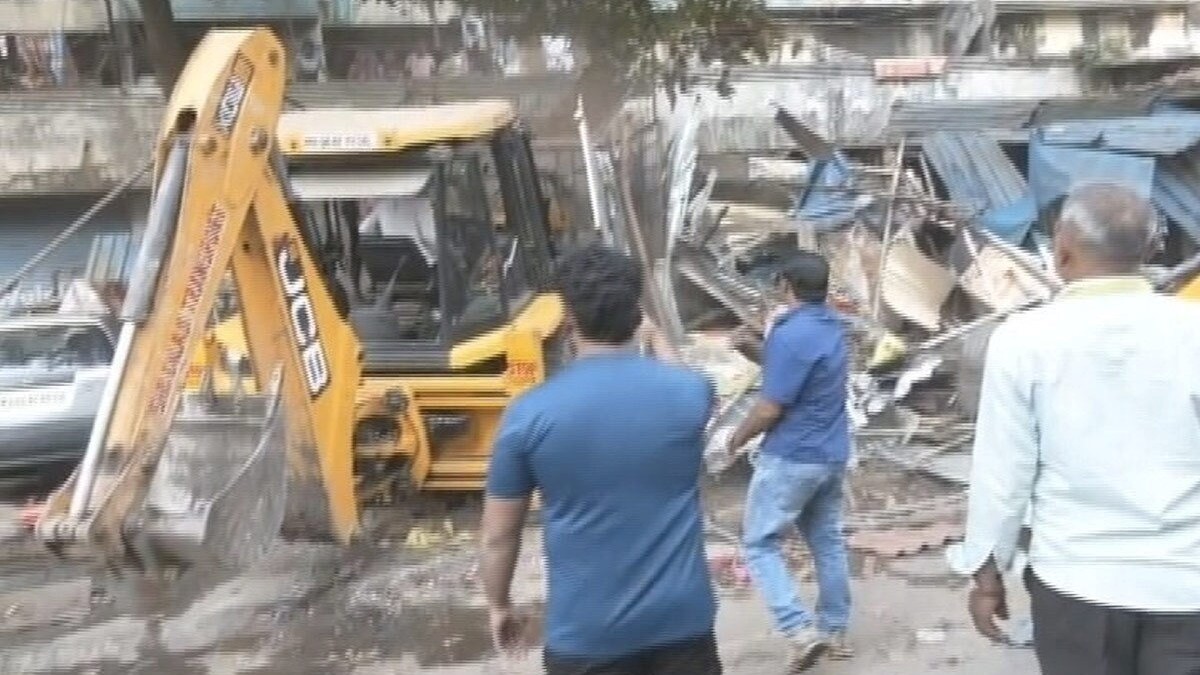
At approximately 5:00 pm, the Mira Bhayander Municipal Corporation’s anti-encroachment division conducted a demolition operation in Naya Nagar. One affected proprietor, operating an automobile repair establishment for twenty-two years, reported being physically removed from his premises by police immediately prior to its demolition, along with fourteen other structures, sustaining an estimated financial loss of five to six lakh rupees; he stated that documentary evidence of tenancy, including utility records, was disregarded by the authorities conducting the operation. A municipal official confirmed that the targeted structures were Muslim-owned, characterising the action as the initial phase of a continuing enforcement drive against unauthorised construction. Estimates of total structures demolished range from twelve to seventeen across contemporaneous reporting, conducted under substantial police presence.
The temporal proximity of the demolition to preceding political statements attracted particular scrutiny: the operation occurred one day following a public statement by Deputy Chief Minister Devendra Fadnavis demanding the “strictest action against the culprits” of the violence, yet the enforcement action was directed exclusively at structures identified as Muslim-owned rather than at any comparable measure against identified Hindu participants in the violence. Residents questioned the temporal coincidence, given that several of the demolished structures had reportedly existed for over two decades without prior enforcement action.
- Asymmetry in State Response
Subsequent independent examination of case documentation revealed a marked disparity in investigative outcomes according to complainant religion. Analysis of eight First Information Reports filed in connection with the violence found that in four cases where the complainant was Muslim, no arrests had been made; further, despite at least twenty-two Muslim-owned commercial establishments having been vandalised during the three-day period, police had not registered a single First Information Report in relation to those incidents at the time of review. This pattern extended to cases involving identifiable video evidence: neither the assault on the Ola driver Ansari nor the attack on the transport vehicle resulted in arrests within the weeks following the incidents, notwithstanding victims’ efforts to assist identification of assailants from circulating footage.
A comparable disparity is evident in the charges applied. Muslim residents implicated in the 21 January confrontation were charged under Section 307 (attempt to murder), carrying a maximum sentence of life imprisonment, on the basis of a First Information Report attributing collective responsibility to a crowd of fifty to sixty persons without individualised allegations. By contrast, Hindu individuals implicated in the assaults on the tempo driver and associated personnel were charged under substantially lesser provisions (Sections 141, 143, 147, 149, 324, 341, and 427), carrying a maximum sentence of three years, notwithstanding video evidence permitting identification of specific assailants.
The demolition operation itself drew formal international criticism. Amnesty International India characterised the action as reflecting a discriminatory de facto policy of using punitive demolition as a response to communal violence, asserting that the operation proceeded without adequate notice or procedural safeguards, and calling instead for prosecution of those responsible for incitement through due legal process.
A partial institutional counterweight subsequently emerged through judicial oversight: the Bombay High Court’s intervention regarding hate speech allegations against Jain and Rane, along with its continuing scrutiny (via writ petition proceedings) of arrest and demolition procedures, indicates that the asymmetry in state response did not proceed entirely without institutional check, though the ultimate disposition of these proceedings remains a matter warranting continued monitoring.
*******
FACT-FINDING REPORT
(Part – II)
Communal Tensions Surrounding Bakri Eid at Poonam Estate Cluster 1, Mira Road, Maharashtra, May 2026
Centre for Study of Society and Secularism (CSSS)
Based on fact-finding undertaken between 30 May and 12 July 2026
1. Background and fact-finding process
In May 2026, communal tensions arose at Poonam Estate Cluster 1, a large residential complex in Mira Road under the jurisdiction of the Mira-Bhayandar Municipal Corporation (MBMC), over the temporary keeping of goats ahead of Bakri Eid.
What began as a dispute concerning a temporary goat enclosure escalated between approximately 22 and 26 May, involving objections from residents, municipal and police intervention, mobilisation of persons from outside the society, violence, involvement of religious and political organisations, and extensive circulation of competing narratives through social and conventional media. The episode significantly damaged relations within a residential community that residents from different faiths had described as historically cosmopolitan.
CSSS began its fact-finding on 30 May. The fact-finding team included Irfan Engineer, Director of CSSS; Sameer Wagle, member of civil society initiative Mumbai for Peace; Rukmini Iyer, peacebuilder; and Sudhakar Suradkar, retired IPS officer. The process included visits to Poonam Cluster; interviews with residents, managing committee representatives, political and community representatives and a person who reported being assaulted; an interview with Nagnath Kamble, associated with the Vishwa Hindu Parishad (VHP) and Bajrang Dal; engagement with senior municipal and police authorities; and observation of police-convened meetings with Muslim residents on 5 July and Hindu residents on 12 July.
CSSS met MBMC Municipal Commissioner Radhabinod A. Sharma, IAS, briefly on 2 July, but did not receive substantive clarification concerning the permissions process or the legal basis for municipal action. Deputy Commissioner of Police Rahul Laxman Chavan, IPS, directed the team to Senior Police Inspector Rajendra Kamble of Kashimira Police Station, who had handled the incident on the ground and subsequently engaged with CSSS.
This report distinguishes corroborated information and official statements from allegations and contested interpretations. Several relevant documents, including FIRs, CCTV footage, some permissions and correspondence, and municipal orders or circulars, were not available to CSSS. Conclusions concerning individual criminal responsibility are therefore outside the scope of this report.
2. The immediate dispute and chronology
Poonam Cluster has a history of collective religious celebrations including Holi, Ganapati, Eid and Muharram. Muslim residents stated that goats had been temporarily kept within the society before Bakri Eid for approximately eight to ten years. They consistently maintained that qurbani, or ritual slaughter, had never taken place within the residential complex and was not intended there in 2026.
There had nevertheless been objections to the goat enclosure for several years. Hemendra Joshi, a Hindu resident who identified himself as a complainant, stated that he had raised objections from 2019 onwards, principally concerning smell and the use of common space. The 2026 conflict therefore involved a longstanding practice that was also subject to longstanding objections.
A police intimation or application was reportedly made around 13-15 May 2026, and Senior PI Kamble subsequently confirmed that police permission had been given on time. Preparation of the temporary enclosure reportedly began around 16 May. The society is also reported to have approached the fire department and MBMC, although the precise documentary trail remains incomplete. Residents stated that an application submitted to MBMC was acknowledged but neither approved nor rejected.
On or around 24 May, MBMC officials removed the asbestos roof of the temporary enclosure, reportedly on fire-safety grounds. The bamboo supports were subsequently removed. The authorities ultimately directed that the goats themselves be removed. Approximately 48 goats were transported on 26 May to a ground near NH School in Naya Nagar, with residents cooperating in their removal.
Senior PI Kamble subsequently stated that many goats lacked medical certificates, ear tags, photographs and other documentation that he said was required, and referred to animal-welfare and transportation requirements. He also maintained that a housing society managing committee could not itself legally authorise the storage of animals.
Residents, however, maintained that they had followed substantially the same practice for years, were willing to comply with applicable rules, and had not been informed of changed or newly enforced requirements despite approaching the authorities. Significantly, Senior PI Kamble stated that after the incident he had recommended that MBMC develop clearer regulations concerning the transportation and management of animals and related arrangements.
3. Escalation and communalisation
The evidence indicates that genuine practical grievances existed concerning smell, hygiene, common space, visitors and society decision-making. These grievances were embedded within a longer deterioration of relations involving disputes over Taraweeh prayers, namaz, loudspeakers, religious lighting and banners, visitors attending religious events, festival committees and the use of common areas.
The conflict changed character when persons and organisations from outside the society became involved. Residents reported the arrival of persons associated with organisations including the VHP and Bajrang Dal. Nagnath Kamble stated that Poonam Cluster residents had approached the VHP for assistance and estimated that the crowd during the disturbances eventually reached 400-500 persons, including organisational members and other citizens.
Physical violence occurred during the disturbances. One person interviewed by CSSS, Rahim, reported being assaulted by a group after stopping near Poonam Cluster to enquire about the gathering. Police personnel reportedly extracted him from the crowd. Other assaults were also alleged. Senior PI Kamble stated that three FIRs had been registered in connection with the episode, while other testimony referred to additional accused persons and incidents. CSSS did not have sufficient documentary evidence to determine individual criminal responsibility.
The appearance of a pig during an already communally charged confrontation became a particularly provocative feature of the episode. Video footage circulated widely. The identity and intention of the person or persons responsible, and the precise circumstances of the incident, could not be conclusively established during the fact-finding.
Political intervention and social media further amplified the controversy. Public narratives increasingly framed the dispute in terms of animal sacrifice within a residential society. This was materially different from the account consistently given to CSSS that goats were being temporarily housed but qurbani was neither practised nor proposed within Poonam Cluster. The conflation of temporary housing, transportation and slaughter contributed to communalising what had initially included practical and regulatory disagreements.
4. Legal and administrative analysis
The legal issues surrounding the incident require several distinct questions to be separated: transportation of goats; temporary keeping of goats; animal welfare; slaughter; municipal regulation; fire and sanitation requirements; and the use of common residential spaces.
The Prevention of Cruelty to Animals Act, 1960[1], particularly Sections 3 and 11, establishes duties concerning animal welfare and prevention of unnecessary suffering. The Transport of Animals Rules, 1978[2], as amended, regulate the transportation of sheep and goats, including veterinary certification, fitness for transport, overcrowding and transport conditions. These provisions are relevant to the transportation and welfare of the animals but do not, by themselves, establish a blanket prohibition on temporarily keeping goats within residential society premises.
The Maharashtra Municipal Corporations Act, 1949[3] gives municipal corporations powers and responsibilities relating to public health, sanitation, markets, slaughterhouses and prevention of cruelty to animals, and enables municipal regulation through statutory powers, bye-laws and administrative measures. CSSS was, however, unable to establish which specific MBMC provision, bye-law or administrative order was relied upon to prohibit or regulate the temporary keeping of goats at Poonam Cluster in May 2026.
The Bombay High Court’s interim order of 6 August 2019 in Jiv Maitri Trust v. Union of India[4] and Others concerned temporary permissions for slaughter during Bakri Eid and restrained permission for slaughter inside individual residential flats. Its subject matter was slaughter, and it does not on its face establish a general prohibition on temporarily keeping goats within residential society premises.
The Maharashtra Animal Preservation Act, 1976[5], as amended, prohibits or regulates the slaughter of specified cattle. Goats are not among the cattle categories whose slaughter is prohibited under the Act, although their slaughter remains subject to other applicable municipal, public-health, animal-welfare and location requirements.
CSSS therefore did not identify a legal provision that, by itself, establishes a blanket prohibition on temporarily keeping goats in every residential society in Maharashtra. This does not establish that the arrangements at Poonam Cluster were lawful: fire safety, sanitation, animal welfare, transportation documentation, municipal rules, cooperative housing requirements and common-space regulations may all apply.
The critical administrative issue is that neither the applicable requirements nor the legal basis for MBMC’s intervention were made sufficiently clear to the affected residents or subsequently to CSSS. If requirements had changed or existing requirements were being enforced differently in 2026, they should have been communicated in advance and applied transparently and consistently.
5. Principal findings
CSSS finds that the immediate controversy concerned the temporary keeping of goats rather than qurbani within Poonam Cluster. Public conflation of these distinct activities contributed to escalation.
The practice of temporarily keeping goats was longstanding, but objections to it also dated back at least to 2019. Genuine practical grievances concerning smell, hygiene, visitors, common space and internal decision-making therefore existed and should not be dismissed as inherently communal.
The regulatory environment was unclear. Different legal questions concerning transportation, animal welfare, temporary housing and slaughter were repeatedly conflated, while MBMC did not provide a clear account of the provisions relied upon in its intervention.
The involvement of outside religious, political and vigilante actors materially transformed an internal residential dispute into a wider communal confrontation. Whatever the merits of residents’ grievances, outside organisations should neither exercise an extra-legal veto over residents’ religious practices nor substitute themselves for lawful authorities and internal dispute-resolution mechanisms.
The incident also exposed a deeper deterioration in trust within Poonam Cluster. Muslim residents subsequently considered suspending public festival celebrations temporarily, while Hindu residents strongly opposed such a measure, particularly in relation to Ganesh Chaturthi. This disagreement could itself become a future flashpoint unless addressed through an inclusive and lawful process.
At the same time, residents from both communities expressed a desire for peaceful coexistence, clearer rules and dialogue. The police-convened engagement following the incident represents a constructive beginning, although dialogue cannot substitute for transparent administration, impartial investigation and consistent enforcement of law.
6. Recommendations
Clear and uniform regulations
MBMC and the police should publish accessible, multilingual guidance well before major festivals, clearly distinguishing requirements relating to transportation and temporary housing of animals, slaughter, sound, common spaces, sanitation, fire safety and crowd management. Rules should not be introduced or newly enforced at the last moment without reasonable notice.
Single-window permissions
MBMC should establish a single-window system or nodal officer coordinating municipal, police, fire, veterinary, transport and other permissions. Comparable administrative facilitation should be available across religious communities.
Impartial enforcement
Authorities should apply laws consistently and proportionately, provide written reasons for approvals and refusals, and avoid selective enforcement. Religious organisers should comply with applicable law in both letter and spirit.
Responsible use of common spaces
Religious activities should take account of sanitation, smell, sound, access, safety, animal welfare and the rights of other residents. Housing societies should establish reasonable arrangements through inclusive processes rather than allowing either longstanding custom or unilateral objections to determine outcomes.
Inclusive internal mechanisms
Poonam Cluster should establish or strengthen a representative festival and welfare mechanism involving different faith communities, owners and tenants, women and senior citizens, with transparent procedures for advance planning and grievance resolution.
Dialogue before escalation
Practical disputes should first be addressed through direct, time-bound local dialogue, supported where appropriate by trained mediators or Mohalla/Shanti Committees. Unresolved legal questions should then be referred promptly to competent authorities.
Prevent external and vigilante interference
Police should act preventively against unauthorised gatherings, intimidation, threats, blockades and attempts by outside groups to impose decisions upon residential communities. Private organisations should not be treated as representatives of entire religious communities.
Address hate speech and misinformation
Sections 196 and 299 of the Bharatiya Nyaya Sanhita, 2023[6] provide relevant offences concerning promoting enmity and deliberate acts intended to outrage religious feelings. The Supreme Court, in Shaheen Abdullah v. Union of India and Others[7], has directed police to take suo motu action where hate speech meeting the legal threshold comes to their notice. Political status or organisational affiliation should not insulate unlawful conduct from scrutiny.
Authorities, political actors, community organisations and the media should also communicate disputes accurately. In the present case, conflating temporary keeping of goats with slaughter significantly distorted public understanding.
Sustained peacebuilding
Mira-Bhayandar requires continuing inter-community engagement through credible Mohalla or Peace Committees, women’s and youth dialogues, joint civic initiatives and rapid-response mechanisms capable of intervening before local disagreements become communal confrontations.
Address municipal infrastructure
MBMC should clarify and fulfil its responsibilities concerning lawful animal markets, slaughterhouse infrastructure, burial grounds and other facilities required by a religiously diverse urban population. Longstanding administrative deficits can create recurring logistical, public-health and communal tensions.
7. Conclusion
The Poonam Cluster incident was neither simply a dispute about goats nor an inexplicable outbreak of communal hostility. It arose through the interaction of longstanding religious practice, genuine local grievances, unclear regulation, weak internal dispute resolution, municipal action, outside mobilisation, political intervention, violence and social-media amplification.
The central lesson extends beyond Bakri Eid. Everyday differences in diverse urban communities will inevitably arise around religious practice, shared space, sound, sanitation and public facilities. When rules are clear, authorities act consistently and communities possess credible mechanisms for dialogue, such differences can remain practical disagreements. When administrative ambiguity, political mobilisation, misinformation and vigilante intervention enter the situation, ordinary disputes can rapidly acquire communal meaning.
Preventing recurrence therefore requires both sound administration and sustained social engagement: transparent and equal application of law, clear permissions, timely grievance resolution, protection from intimidation, responsible political and media conduct, and dialogue that respects religious difference while protecting shared civic space.
Legal and public sources consulted
- The Prevention of Cruelty to Animals Act, 1960, especially sections 3 and 11. India Code, Government of India.
- The Transport of Animals Rules, 1978, as amended, including provisions governing transport of sheep and goats. Animal Welfare Board of India.
- The Maharashtra Municipal Corporations Act, 1949. India Code, Government of India.
- Jiv Maitri Trust v. Union of India and Others, Bombay High Court, interim order dated 6 August 2019.
- The Maharashtra Animal Preservation Act, 1976, as amended.
- The Bharatiya Nyaya Sanhita, 2023, sections 196 and 299. India Code, Government of India.
- Shaheen Abdullah v. Union of India and Others, Supreme Court of India, orders directing police authorities to register cases Suo motu where hate speech meeting the legal threshold comes to their notice.
[1] The Prevention of Cruelty to Animals Act, 1960, especially sections 3 and 11. India Code, Government of India.
[2] The Transport of Animals Rules, 1978, as amended, including provisions governing transport of sheep and goats. Animal Welfare Board of India.
[3] The Maharashtra Municipal Corporations Act, 1949. India Code, Government of India.
[4] Jiv Maitri Trust v. Union of India and Others, Bombay High Court, interim order dated 6 August 2019.
[5] The Maharashtra Animal Preservation Act, 1976, as amended.
[6] The Bharatiya Nyaya Sanhita, 2023, sections 196 and 299. India Code, Government of India.
[7] Shaheen Abdullah v. Union of India and Others, Supreme Court of India, orders directing police authorities to register cases suo motu where hate speech meeting the legal threshold comes to their notice.
Bibliography:
Newslaundry. “‘Duty of state to protect all people’: Amnesty India condemns bulldozer action in Mira Road.” January 25, 2024. https://www.newslaundry.com/2024/01/25/amnesty-international-india-condemns-bulldozer-action-maharashtra
Scroll.in. “Punitive demolitions of Muslims’ properties must stop: Amnesty after Mira Road bulldozer action.” January 31, 2024. https://scroll.in/latest/1062683/punitive-demolitions-of-muslims-properties-must-stop-amnesty-after-mira-road-bulldozer-action
Deccan Herald. “Clash between two groups in Mumbai over chanting Lord Ram slogans, 6 detained.” January 22, 2024. https://www.deccanherald.com/india/maharashtra/clash-between-two-groups-in-mumbai-over-chanting-lord-ram-slogans-6-detained-2858748
Deccan Herald. “Ex-BJP MLA to lead peace march in Thane on Jan 26.” January 25, 2024. https://www.deccanherald.com/india/maharashtra/ex-bjp-mla-to-lead-peace-march-in-thane-on-jan-26-2863824
Deccan Herald. “Mira Road clashes: Bulldozer action initiated following violence over Ram Mandir rally in Mumbai.” January 23, 2024. https://www.deccanherald.com/india/maharashtra/mira-road-clashes-bulldozer-action-initiated-following-violence-over-ram-mandir-rally-in-mumbai-2860899
Deccan Herald. “Security beefed up at Mira Road.” January 2024. https://www.deccanherald.com/india/maharashtra/security-beefed-up-at-mira-road-2862897
India TV News. “Mumbai: Tension persists in Mira Road post Ram Temple rally; bulldozers act on illegal constructions.” January 23, 2024. https://www.indiatvnews.com/maharashtra/mumbai-tension-mira-road-post-ram-temple-rally-bulldozers-act-illegal-constructions-maharashtra-naya-nagar-locality-saffron-flags-ayodhya-2024-01-23-913302
Maktoob Media. “After violent Ram temple celebrations, clashes, authorities demolish Muslims’ shops in Mumbai’s Mira Road.” January 23, 2024. https://maktoobmedia.com/india/after-violent-ram-temple-celebrations-clashes-authorities-demolish-muslims-shops-in-mumbais-mira-road/
The Quint. “‘Pulled My Hair, Hurled Abuses at My 12-Yr-Old’: Woman in Viral Mira Road Video.” January 27, 2024. https://www.thequint.com/news/india/mira-road-woman-attacked-hindu-muslim-communal-riots-police-fir-naya-nagar-mumbai-thane-latest-news
The Wire. “‘Police Didn’t Stop the Mob’: Shopkeepers, Injured Recount Hindutva Violence at Mumbai’s Mira Road.” January 24–25, 2024. https://m.thewire.in/article/communalism/police-didnt-stop-the-mob-shopkeepers-injured-recount-hindutva-violence-at-mumbais-mira-road (also archived via Dailyhunt: https://m.dailyhunt.in/news/india/english/the+wire+english-epaper-wireng/police+didnt+stop+the+mob+shopkeepers+injured+recount+hindutva+violence+at+mumbais+mira+road-newsid-n577210038)
ThePrint. “‘Not Hindu-Muslim row’: Mira Road residents say politicians changing nature of ‘peace haven’.” January 2024. https://theprint.in/india/not-hindu-muslim-row-mira-road-residents-say-politicians-changing-nature-of-peace-haven/1940641/
ThePrint. “Ram temple has erased the violence of 1992 from public memory. Mira Road is a reminder.” February 28, 2025. https://theprint.in/opinion/newsmaker-of-the-week/ram-temple-has-erased-the-violence-of-1992-from-public-memory-mira-road-is-a-reminder/1941437/
ThePrint. “‘Why did it take 22 yrs?’ Muslim-majority area questions timing of demolition drive in Mira Road.” February 28, 2025. https://theprint.in/india/why-did-it-take-22-yrs-muslim-majority-area-questions-timing-of-demolition-drive-in-mira-road/1938697/
Scroll.in. “Why the police investigation into Mira Road violence has left Muslims with little hope of justice.” February 13, 2024. https://scroll.in/article/1063469/is-police-investigation-into-mira-road-riots-biased-against-muslims
Scroll.in. “‘They saw a Muslim name and attacked’: How Hindutva mobs ran amok in Mira Road.” January 30, 2024. https://scroll.in/article/1062772/they-saw-a-muslim-name-and-attacked-how-hindutva-mobs-ran-amok-on-mira-road
The Mooknayak (English). “Mira Road Violence Sparks Debate on ‘Muslim Areas’ and Societal Ghettoization.” January 27, 2024. https://en.themooknayak.com/minority-news/mira-road-violence-sparks-debate-on-muslim-areas-and-societal-ghettoization
The Mooknayak (English). “Mumbai: Why Bulldozer Actions Often Come After Violence, Crime if It’s Really Routine Affair, Ask Mira Road Residents.” February 6, 2024. https://en.themooknayak.com/minority-news/mumbai-why-bulldozer-actions-often-come-after-violence-crime-if-its-really-routine-affair-ask-mira-road-residents
Land Conflict Watch. “17 ‘illegal’ shops demolished in Naya Nagar near Mumbai, days after communal clashes in Mira Road.” October 4, 2024. https://www.landconflictwatch.org/conflicts/17-illegal-shops-demolished-in-naya-nagar-near-mumbai-days-after-communal-clashes-in-mira-road
Radiance News / Radiance Weekly. “Unmasking ‘ghettoization’ — on why there are ‘Muslim areas’ in modern India.” January 27, 2024. https://radiancenews.com/unmasking-ghettoization-on-why-there-are-muslim-areas-in-modern-india/ (also: https://radianceweekly.net/unmasking-ghettoization-on-why-there-are-muslim-areas-in-modern-india/)
OpIndia. “INC candidate from Mira Bhayandar, Muzzafar Hussain opposed Yakub Memon’s hanging; is son of founder of Nayanagar, where Hindus are hardly allowed today.” November 9, 2024. https://www.opindia.com/2024/11/meet-muzzafar-hussain-the-congress-candidate-from-mira-bhayandar-who-opposed-yakub-memons-hanging-and-whose-father-founded-nayanagar-where-hindus-are-hardly-allowed-today/